By Fraser Black – Managing Director, NineFiftyNine.net
Search is changing faster than at any point since Google first became dominant. AI-powered search platforms like ChatGPT, Perplexity, Gemini and Google’s AI Overviews are fundamentally reshaping how people discover information, research brands and make decisions.
At 959, we’ve felt this shift firsthand – not as a future trend, but as a present-day reality affecting traffic patterns, attribution models and client expectations. The days of measuring success purely by rankings and clicks are over. In an AI-first world, visibility, credibility and measurable business impact matter far more than blue links.
Across the industry, digital agencies are being forced to adapt quickly. Those who don’t risk becoming irrelevant. Those that do are rethinking everything from SEO fundamentals to how value is communicated and proven to clients.
AI search doesn’t replace Google – it compresses the journey
One of the biggest misconceptions we still encounter is that AI search is “replacing” Google. It isn’t. Instead, it’s compressing the customer journey.
For many informational queries, the journey now ends inside the AI interface. Users ask a question, receive a synthesised answer, and never click through to a website. This explains the sharp drop in click-through rates many brands are seeing – especially at the top of the funnel.
At the same time, users still rely heavily on Google to validate and verify AI-generated recommendations. The result is a more circular, less linear search journey – one that blends AI discovery with traditional search validation.
The data supports this shift. AI-referred traffic converts dramatically better than standard organic visits, because users arrive far more informed and far closer to a decision. This has major implications for how agencies should think about optimisation and reporting.
What this shift means for agencies – and for 959
From our perspective, four priorities have become unavoidable:
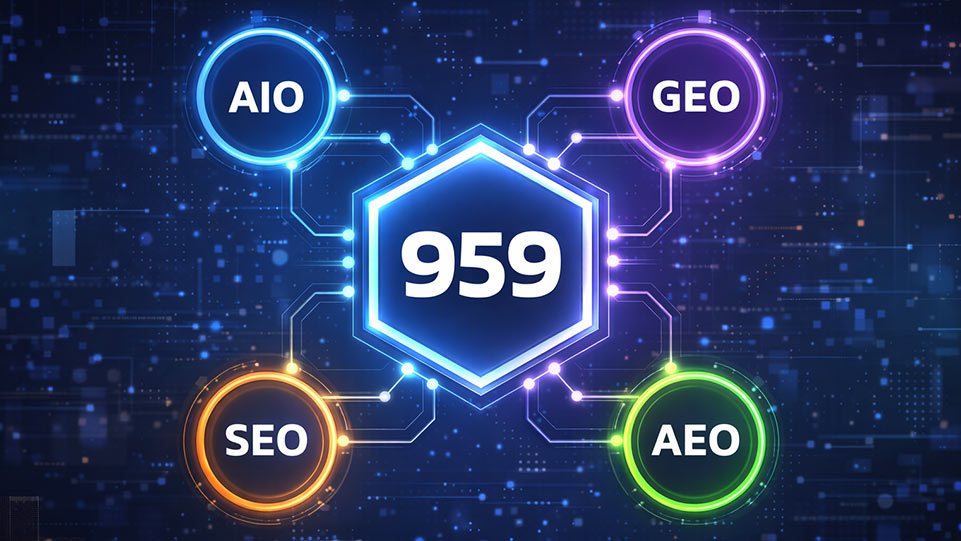
- Expanding beyond traditional SEO to include AI Optimisation (AIO) and Generative Engine Optimisation (GEO), without abandoning organic search fundamentals.
- Educating clients on how AI search works, why visibility now extends beyond websites, and why traffic volume alone is no longer the primary success metric.
- Introducing new performance indicators that reflect brand presence, citations and influence within AI-generated answers.
- Moving toward value-based selling, where outcomes and business impact matter more than easily attributable clicks.
This is exactly how 959 has evolved its approach.
From keyword rankings to brand-level visibility
Like many forward-thinking agencies globally, we’ve moved decisively away from keyword-first optimisation as the core strategy. Keywords still matter – but they’re no longer the starting point.
Today, AI systems don’t just rank pages; they interpret brands, entities and expertise. If your brand isn’t clearly understood as a trusted authority in its space, it won’t surface consistently in AI answers – regardless of how well a single page is optimised.
That’s why 959 now focuses heavily on brand entity building. This includes aligning content, expertise signals, structured data, digital PR and citations so that AI systems can clearly understand:
- who our clients are,
- what they specialise in,
- and why they should be trusted.
This mirrors a broader industry shift toward entity- and intent-driven optimisation, where clarity and trust matter more than tactical keyword wins.
Why authority signals and listicle visibility matter more than ever
Another clear trend we’ve embraced is the growing importance of third-party validation. AI systems frequently cite “best of” lists, editorial roundups and authoritative publications when generating answers.
As a result, listicle placements and brand mentions have become significantly more valuable than traditional link building alone. At 959, we now prioritise earned visibility in trusted editorial environments that AI platforms consistently reference.
This isn’t about gaming the system. It’s about understanding how AI sources information – and ensuring our clients are present where those systems look for signals of authority.
Technical foundations still matter – but for machines as much as humans
One thing hasn’t changed: weak technical foundations undermine everything.
Clean site architecture, structured data, schema markup and consistent entity references are now table stakes – not just for search engines, but for AI systems interpreting content at scale.
At 959, we’ve tightened technical SEO standards across all clients, with a specific focus on machine readability. The goal is simple: remove friction and ambiguity so both humans and AI can clearly understand the brand story being told.
Rethinking measurement in an AI-driven world
Perhaps the biggest shift has been in how we measure success.
Traditional attribution models struggle in an environment where discovery happens inside AI tools and influence occurs before a user ever visits a website. That’s why we’ve introduced new metrics focused on:
- AI visibility and citation presence
- brand mentions within AI responses
- assisted conversions influenced by AI discovery
- downstream performance rather than entry-point traffic alone
This allows us to have more honest, outcome-driven conversations with clients – and to prove ROI even as attribution becomes more complex.
The future belongs to adaptable agencies
The AI search era doesn’t reward agencies that cling to old playbooks. It rewards those willing to evolve, educate and reframe success.
At 959, we see AIO and GEO not as replacements for SEO, but as its natural evolution. The fundamentals still matter – quality content, technical excellence and authority signals – but how those fundamentals are interpreted has changed.
Our role as an agency is no longer just to drive traffic. It’s to ensure our clients are discoverable, trusted and chosen – wherever that decision begins.
And increasingly, that beginning is AI.
Looking to adapt your current strategy? Let’s Talk.